

Oscilloscope Calibration: Turnaround Times, On-Site Services & How It Works
Tra-Cal Lab has provided ISO/IEC 17025 accredited, NIST-traceable oscilloscope calibration for over 35 years — trusted by NASA, the U.S. military, and NIST. We calibrate high-bandwidth digital and mixed-signal oscilloscopes, verifying vertical (gain) accuracy, timebase, bandwidth, and trigger performance, with faster turnaround and lower cost than the OEM. We offer expedited services, on-site calibration and Mid-Atlantic pickup and delivery to keep your operation running. Every certificate includes as-found/as-left data, so your measurements stand up to any audit.
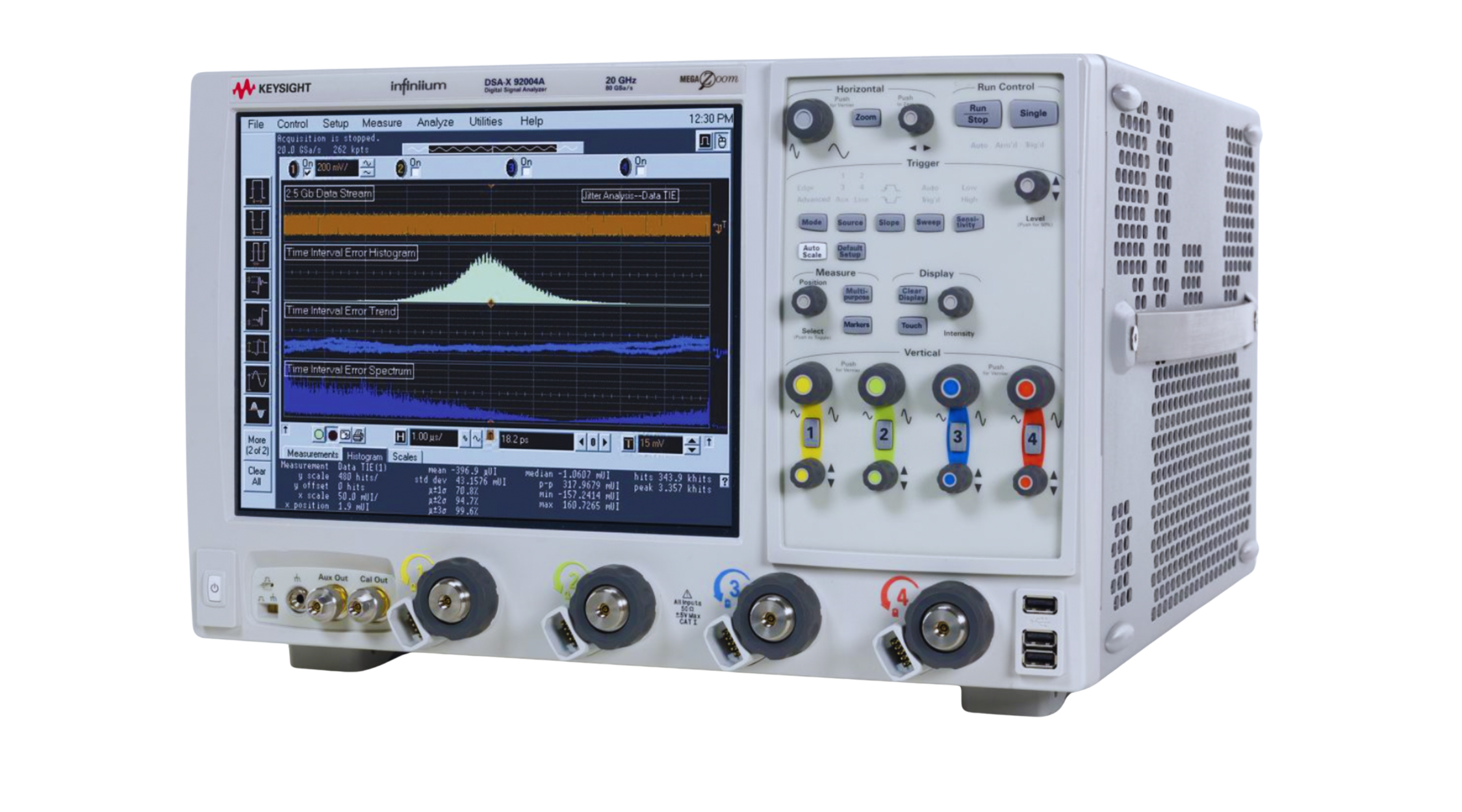
Key Summary
Oscilloscope calibration compares the instrument's measurements — vertical/gain accuracy, timebase, bandwidth, and trigger — against precision standards traceable to NIST, with results documented on a calibration certificate. Turnaround is typically 3-5 days standard (overnight rush available), and most oscilloscopes should be calibrated every 12 months by an ISO/IEC 17025 accredited lab.
Why Choose Tra-Cal?
ISO/IEC 17025 Accredited
Our lab is independently audited every year by ANAB to the industry's most rigorous quality standard, so every calibration is audit-proof.
Overnight Rush Available
When downtime isn't an option, expedited service gets your instrument calibrated and back in your hands overnight or within three days.
NIST-Traceable
Every measurement we make traces directly back to national standards, giving your results documented accuracy you can defend.
Trusted by NASA, the U.S. Military, and NIST
The organizations with the most demanding measurement requirements in the country choose Tra-Cal — yours can too.
Oscilloscope Calibration Turnaround
| Service | Turnaround |
|---|---|
| On-site Calibration Service | Same-Day |
| Standard calibration with certificate | 3-5 business days |
| ISO/IEC 17025 accredited calibration | 4-6 business days |
| Expedited / rush | Overnight to 3 days |
Oscilloscope Brands & Models We Calibrate
| Manufacturer | Popular Models We Calibrate |
|---|---|
| Tektronix | TDS3024B, TDS3054B, TDS3054C, MDO34, MSO46, TDS1012, TDS744A |
| Keysight | DSOX3034A |
| Hewlett Packard | 54600A |
| Rohde & Schwarz | MXO44, RTA4004 |
| National Instruments | PXI-5114 |
We support over 100 test equipment manufacturers — contact us and we’ll confirm coverage for your exact instrument.
Don’t see your model?

Equipment & Standards Required
We maintain the following equipment and conditions required to calibrate an oscilloscope accurately:
Precision multifunction calibrator with at least a 4:1 test accuracy ratio
Manufacturer’s calibration procedure and specifications
Stable environment: 23 °C ± 5 °C, controlled humidity
NIST-traceable reference standards and documentation system

How to Calibrate an Oscilloscope: Step-by-Step
Step 1: Stabilize the environment and warm up the instrument. Allow the oscilloscope and reference standards to acclimate for at least 30 minutes at 23 °C ± 5 °C.
Step 2: Perform “as found” verification. Record readings on every function and range before any adjustment. As-found data proves whether prior measurements were valid.
Step 3: Verify vertical/gain accuracy, timebase and bandwidth, and trigger performance across ranges. Apply known reference values at multiple points across each range and compare against manufacturer tolerance limits.
Step 4: Adjust, re-verify, and document. Adjust any out-of-tolerance functions, repeat the verification, and issue a calibration certificate with as-found/as-left data and measurement uncertainty.
Pro tip from our lab: Always request as-found/as-left data on your certificate. Without it, you can’t assess whether measurements taken before calibration were reliable — a common audit finding.

How Often Should You Calibrate an Oscilloscope?
| Usage Profile | Recommended Interval | Notes |
|---|---|---|
| Daily industrial / field use | Typically 6–12 months, adjusted based on documented risk assessment and historical stability data per the lab’s calibration program | Shorten after drift or overload events |
| General lab / bench use | Typically 6–12 months, adjusted based on documented risk assessment and historical stability data per the lab’s calibration program | Reviewed as necessary to maintain confidence in the equipment |
| Regulated / quality-system environments (e.g., ISO 9001, FDA) | Typically 6–12 months, adjusted per documented risk assessment and historical stability data | Interval must be documented and justified |
ISO/IEC 17025 does not specify fixed calibration intervals. It requires that intervals be reviewed and adjusted as necessary to maintain confidence in the equipment. Recommended intervals are typically 6–12 months, adjusted based on documented risk assessment and historical stability data per the lab’s calibration program. A2LA and ANAB are accreditation bodies — distinct from quality-system frameworks such as ISO 9001 or FDA requirements.
Frequently Asked Oscilloscope Questions
Q: How much does oscilloscope calibration cost?
A: Oscilloscope calibration cost depends on the model, bandwidth, channel count, options installed, and whether accredited (17025) certification is required. Contact Tra-Cal for a quote.
Q: Can I calibrate an oscilloscope myself?
A: You can perform verification checks against a known reference, but formal calibration requires traceable standards with a 4:1 accuracy ratio and documented uncertainty.
Q: What is the difference between calibration and adjustment?
A: Calibration is the documented comparison against a standard; adjustment is the correction made when readings fall outside tolerance.
Q: How long does calibration take?
A: Standard turnaround is typically 3-5 business days; Tra-Cal offers expedited service options.